
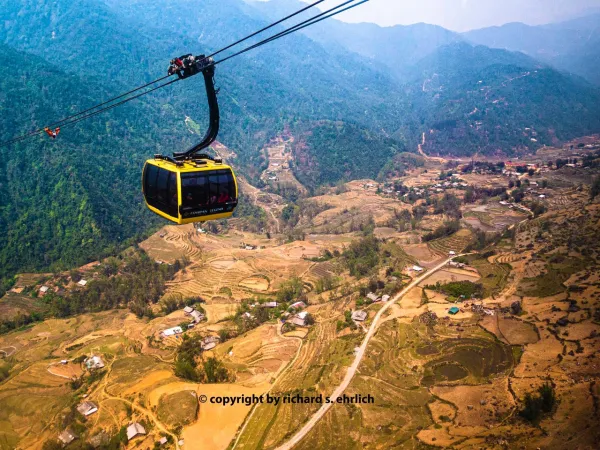
Tourists visit Fansipan by riding inside a group-sized pod attached to a four-mile-long cable which lifts them above rolling, terraced farmland and the mountain's forests to a modern station on the peak. Photo copyright by Richard S. Ehrlich
 BANGKOK, Thailand -- Vietnam is digging up a graveyard so a sprawling Trump International golf resort with plush residences can be built along the Red River, while "the highest Starbucks Coffeehouse in Asia" has opened on Vietnam's tallest mountain peak near Sapa.
Trillionaire Elon Musk meanwhile received a Starlink satellite operating license in February to expand Vietnam's censored internet.
And Apple CEO Tim Cook told CNBC news last year for U.S. sales of "Mac and iPad and AirPods and the Watch, almost all of the country of origin is Vietnam."
Hanoi's eager embrace of American capitalism spotlights how vastly U.S.-Vietnam relations have changed since their grueling 10-year war ended with a communist victory in 1975.
Hanoi favors close ties with Washington to balance its economic vulnerability with China, its giant trading partner across Vietnam's northern frontier.
U.S. investments in Vietnam meanwhile appear to be growing.
President Trump's family convinced Vietnam's government to permit the toppling of gravestones and exhumation of coffins so a cemetery could become a "Trump International Vietnam" golf resort and luxury real estate project with five-star hotels and upscale villas.
"To put its immense scale into perspective, the project is comparable in size to Newark Liberty International Airport in New Jersey," said Legal Initiatives for Vietnam (LIV), a human rights group based in Taiwan and registered in California.
The $1.5 billion project is spread across 2,446 acres of flat, fertile land along the Red River in northern Vietnam's Hung Yen province, with a 50-year operating license.
Digging began last year despite residents protesting the forced disinterring of more than 3,500 ancestorial graves and rehousing of more than 4,000 families with insufficient compensation.
"The Trump Organization is not directly responsible for these [compensation] payments. Vietnamese developers are managing the project, while the Trump Organization receives licensing fees and will operate the club upon completion," LIV said.
At the May 2025 groundbreaking, the Trump Organization announced: "Strategically located just 45 minutes from Hanoi, Trump International Vietnam is more than a luxury destination, it is a living icon of a new era."
The project was supported by Vietnam's recently reelected President To Lam, the Finance Ministry, and the Hung Yen People's Committee which is a communist government group involved in managing the province.
"The Ministry of Defense and Ministry of Public Security will guide local authorities and investors on defense and security matters, including the sale of housing to foreigners," Vietnam's Bac Ninh news reported.
"The complex will include two eco-residential areas featuring ecological golf courses, accommodating a combined population of 5,300" people, Vietnam's Tuoi Tre News said.
"Additionally, it will have a commercial urban services area for 29,700 people, green spaces, themed parks, and a social housing area."
IDG Capital Vietnam "represents the Trump Organization in the project," Tuoi Tre said.
IDG Capital Vietnam's Charles Bowman discussed the project in Hanoi last year with Pham Minh Chinh whose prime ministry ended in April.
Mr. Pham "suggested the Trump Organization consider Vietnam as a strategic business hub, exploring investment and business expansion into other localities and potential sectors where the company has strengths and Vietnam is prioritizing development," Tuoi Tre reported.
"Kinh Bac City (KBC) Development Holding Corp. [is] holding the majority of the charter capital," LIV said.
"Specifically, Hung Yen Investment and Development Group Joint Stock Company (HYG) -- a subsidiary of KBC in which is is 95 percent owned -- contributed 99 percent of the charter capital to establish Trump International Vietnam Joint Stock Company," a government statement said.
"This resulted in Trump International Vietnam being identified as a company controlled by KBC with an indirect ownership stake of 95.32 percent," by KBC, it said referencing KBC's report to Hanoi's Securities Commission.
Seattle-based Starbucks meanwhile announced it opened "the highest Starbucks Coffeehouse in Asia on Fansipan Mountain" on the outskirts of Sapa city in nothern Lao Cai province.
Fansipan's 10,312-foot (3,143-meter) peak is the highest in Indochina which includes Vietnam, Cambodia and Laos.
"From its position on the 'Roof of Indochina,' customers can enjoy their favorite Starbucks beverages while taking in panoramic views of the Sapa highlands," the company said in March.
Tourists visit Fansipan by riding inside a group-sized pod attached to a four-mile-long cable which lifts them above rolling, terraced farmland and the mountain's forests to a modern station on the peak.
The spacious Starbucks nestles amid large, relatively new, stone-built pavilions and a bell tower, a gigantic Buddha, Chinese shrines, and statues erected on the peak.
Vietnam meanwhile is grappling with corruption, population density, impoverished rural zones, and demands for free speech and other rights while adapting to the 21st century and welcoming foreign investment.
The central coastal city of Da Nang is now a leading destination for international digital nomads who settle in locations which offer work-from-anywhere facilities, fast internet, and other lures.
In a list of the "Top Cities For Creators And Digital Nomads In 2026," Forbes magazine reported in April:
"Da Nang is emerging as a fast-growing hub for digital entrepreneurs, combining affordability, strong infrastructure, and a coastal lifestyle that supports long-term, location-flexible work.
"At a foundational level, that includes reliable infrastructure: high-speed internet, co-working spaces, and housing designed for longer stays," Forbes said.
In February, the State Department endorsed former President Joseph Biden's 2023 U.S.-Vietnam Comprehensive Strategic Partnership, which was unveiled during his Hanoi state visit.
The 2023 "strategic" upgrade in relations elevated former President Barack Obama's 2013 U.S.-Vietnam Comprehensive Partnership.
The State Department endorsed the partnership designed to strengthen "cooperation on law enforcement and security intelligence, collaborate and exchange information and experiences to increase the effectiveness of maritime cooperation and efforts to counter transnational crimes, piracy, money laundering, human trafficking, illegal trafficking of narcotics and precursor chemicals, cybercrime, and high-tech crime."
Hanoi is also cooperating with the State Department and Department of Homeland Security, and "welcomed" at least 170 Vietnamese illegal immigrants deported from the U.S.
"Vietnam has been accepting returnees faster since agreeing under U.S. pressure in early 2025 to expedite repatriation requests," Hanoi-based VnExpress news reported in March.
"More than 8,600 Vietnamese nationals in the U.S. have standing removal orders, according to [U.S.] Immigration and Customs Enforcement data, though the number includes long-term residents who arrived as refugees decades ago," VnExpress said.
On June 10, U.S. Deputy Secretary of State Christopher Landau met Vietnam's Deputy Prime Minister Phạm Gia Tuc in Hanoi to strengthen economic, security, and diplomatic relations.
The U.S. buys more than $150 billion of Vietnam's exports, making Washington vital to the Southeast Asian nation's economy, but sells only $15 billion worth of goods to the Vietnamese -- resulting in a troubling trade surplus.
Vietnam imports more than $180 billion worth of goods from China, while selling about $70 billion to the Chinese.
Hanoi's balancing act between Washington and Beijing may be increasing in favor of China, possibly resulting in more competition for the U.S.
For example, Vietnamese President Lam on an April state visit to Nanning, China, was offered sleek high-speed Chinese trains, enhanced rail links, and other ways to streamline trade and travel.
Past U.S. involvement in Vietnam meanwhile still haunts the country, highlighted by the recent discovery of a suspected "mass grave" of an estimated 900 North Vietnamese communist soldiers buried under a park in Ho Chi Minh City after Hanoi's 1968 Tet Offensive against U.S. and South Vietnamese forces.
"Muoi Bi, the cemetery manager at the time, said these were the bodies of commando fighters who died in the assault on the radio station and the U.S. Embassy," VnExpress reported.
After an eight-year forensic, above-ground inspection, Vietnamese officials on June 8 said Le Thi Rieng Park was built in 1983 over the mass grave, eight years after the war ended.
"Nguyen Thanh Phuoc, 70, who grew up nearby, remembered the cemetery manager spreading DDT over the bodies as they went into the ground," VnExpress reported.
Mr. Phuoc described "corpses that were bloated and, in places, burned. Some of the dead still wore belts of AK [AK-47 assault rifle] ammunition."
Forensics determined the bodies were buried in three trenches between what later became a children's playground and a fish-filled lake.
Investigators "tracked down three photographs of a mass burial, then fixed their position by layering declassified U.S. reconnaissance satellite images from 1968 to 1972 archived by the U.S. Geological Survey, against French military aerial photos from 1951, commercial satellite imagery from Maxar and Airbus, and a run of old Saigon city [Ho Chi Minh City] maps."
*****
Richard S. Ehrlich is a Bangkok-based American foreign correspondent reporting from Asia since 1978, and winner of Columbia University's Foreign Correspondents' Award. Excerpts from his two new nonfiction books, "Rituals. Killers. Wars. & Sex. -- Tibet, India, Nepal, Laos, Vietnam, Afghanistan, Sri Lanka & New York" and "Apocalyptic Tribes, Smugglers & Freaks" are available at https://asia-correspondent.tumblr.com